Skip to product information
1 of 13

Zabuton - Natural Persimmon (Kakishibu) Hand Dyeing - Meisen Size

Zabuton - Natural Persimmon (Kakishibu) Hand Dyeing - Meisen Size

Regular price $148.00 USD
Regular price Sale price $148.00 USD
Sale Sold out
Natural Persimmon (Kakishibu) Dye Color
Meisen-size Zabuton

Fabric Size: 59 x 55 cm (23.2 x 21.7 in)
Cotton Filling Weight: 1.0 kg (2.2 lb)
Quantity

View full details

Features

  • Meisen-size Zabuton
  • Fabric Size: 59 x 55 cm (23.2 x 21.7 in)
  • Fabric: 100% ramie
  • Filling: 100% organic cotton
  • Cotton Filling Weight: 1.0 kg (2.2 lb)
  • Naturally hand-dyed with Kakishibu persimmon dye
  • Made in Japan

Kakishibu Dyeing

Kakishibu is a traditional Japanese dye made from the fermented juice of unripe persimmons. The dye used for this fabric is made from persimmons grown in the Minamiyamashiro region of Kyoto, an area known for persimmons with a high tannin content.

Mountain water is used during the dyeing process. The color gradually deepens with exposure to light and air, giving each piece its own character over time.

Because this is a natural dye, a slight Kakishibu scent may remain when the item is new. The scent gradually fades with airing and use.

Subtle variations in color and weave are natural characteristics of hand-dyed and handwoven fabric.


Handwoven Ramie and Natural Dyeing

This handwoven ramie fabric is dyed by hand in Japan using Kakishibu made from persimmons grown in the Minamiyamashiro region of Kyoto.

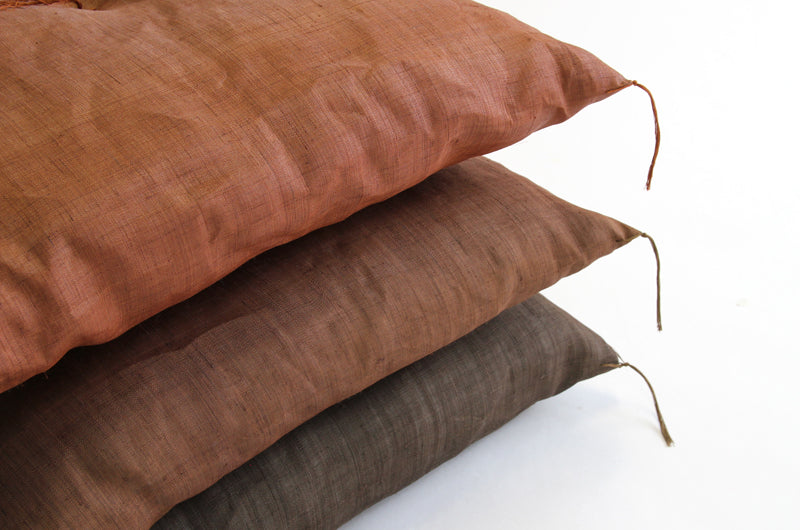
  • Dark Brown - Tetsubai
    Kakishibu fabric treated with an iron mordant, creating a darker brown to near-black color.
  • Brown - Kakishibu
    Warm brown tones that gradually deepen with light and air.
  • Red Brown - Tamashibu
    A brighter reddish-brown Kakishibu finish with a slight sheen and firmer feel.
  • Undyed - Natural Color
    Natural handwoven ramie with no added dye.

Filling

The filling is 100% organic cotton.

Our craftspeople layer and shape the cotton by hand, distributing it carefully so the Zabuton is evenly filled and supported through the center and edges.

The cotton has a firm, supportive fiber that works well for traditional Japanese cushions. It feels soft and full when new, then gradually settles and becomes denser with use.

No wool, polyester, flame retardants, pesticides, or adhesives are added to the filling.

Learn more about our organic cotton.

Craftsmanship: How We Make a Zabuton

Each Zabuton is made by hand using traditional Japanese futon-making techniques.

  • Layers of cotton are arranged by hand to create an even foundation.
  • The cotton is shaped and distributed carefully so that the filling reaches the edges while providing support at the center.
  • Each corner is filled and shaped by hand to form the final shape of the cushion.
  • After the cotton is inserted, the opening is sewn closed by hand with a blind stitch.

The shape and balance of each Zabuton are adjusted by hand as it is finished.

About Flat Dimensions

The listed dimensions are measured from seam to seam while the Zabuton is lying flat and unfilled.

Once the cotton filling is added, the Zabuton gains volume, so the finished length and width become smaller than the listed flat dimensions.

When new, the Zabuton is approximately 5–10 cm (2.0–3.9 in) thick. With use, the cotton gradually settles to around 3–5 cm (1.2–2.0 in).

Finished size and thickness may vary slightly depending on the amount of filling, temperature, humidity, and use.

Care for 100% Cotton Filling

• Do not wash with water at home.
• Air regularly in a dry, well-ventilated place.
• On clear, dry days, air the item outdoors to help release moisture from the cotton filling.
• If outdoor airing is not possible, place it in a well-ventilated room and use a fan or dehumidifier if needed.
• If the outer fabric becomes dirty, gently spot clean the affected area and allow it to dry completely.
• Store only when completely dry, in a well-ventilated place.
• Cotton naturally settles and becomes firmer with use. This is a normal characteristic of cotton-filled bedding.